
Laboratory Services
Cellular Biology
The Cellular Biology Laboratory provides advanced cell culture services, with expertise ranging from the isolation of cells from specific tissues to the reprogramming and differentiation of induced pluripotent stem cells (iPSCs).
All materials used are quality-certified and subject to preliminary testing before entering the production workflow. Laboratory methods are internally developed, standardized, and continuously updated through ongoing technical and scientific staff training.
In addition to specialist consulting services, the laboratory can develop customized solutions tailored to specific client requirements.
Isolation and Establishment of Lymphoblastoid Cell Lines from Peripheral Blood
Mononuclear cells are isolated through density-gradient separation and subsequently immortalized using Epstein-Barr Virus (EBV).
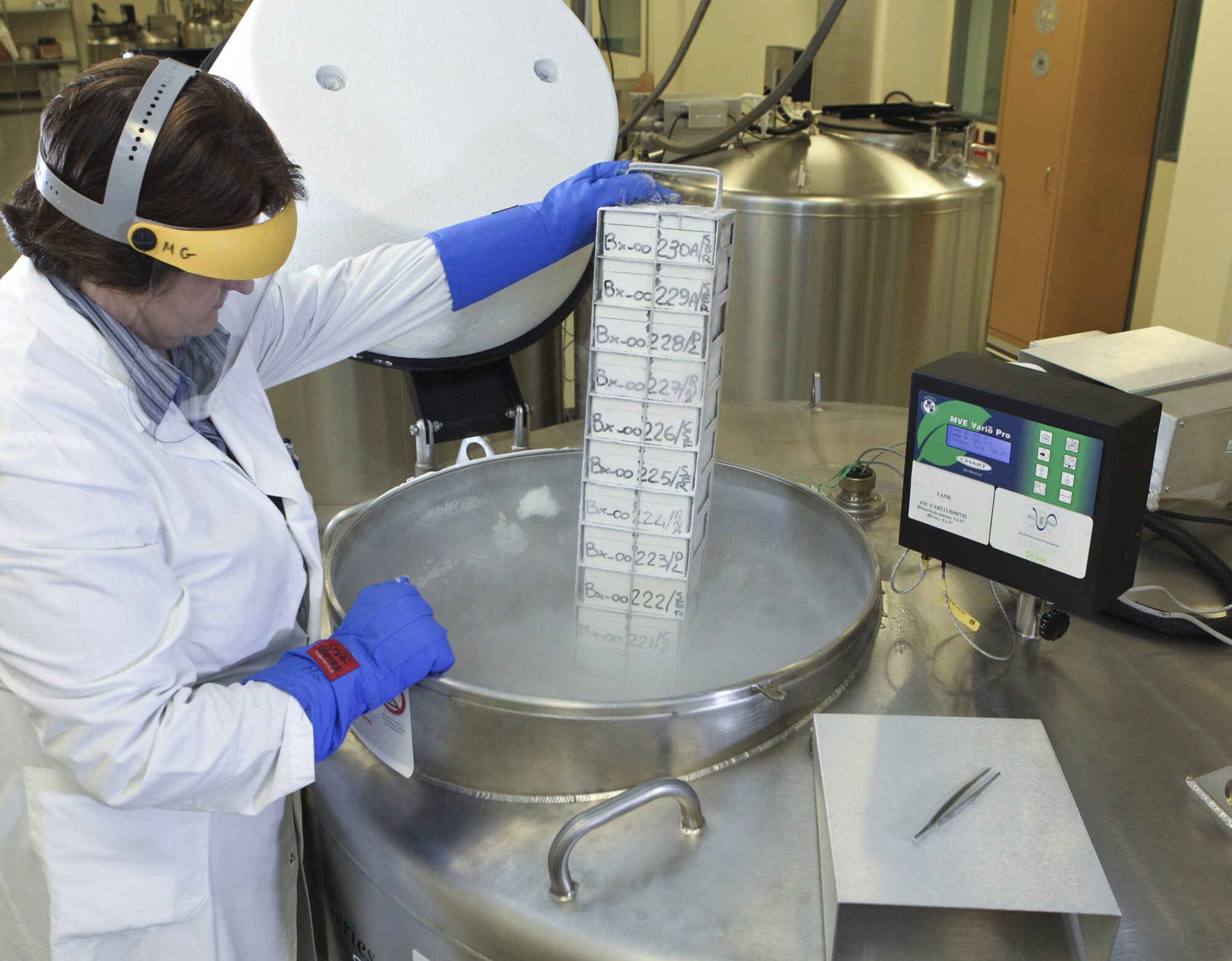
Cell cultures are expanded without antibiotics until sufficient cell numbers are obtained for cryopreservation in DMSO and frozen using controlled-rate freezing protocols.
Each cell stock undergoes rigorous quality control testing for:
- Viability
- Sterility (absence of bacterial, fungal, and mycoplasma contamination)
- Genotyping verification
Quality Control, Characterization and Expansion of Cell Lines
The laboratory offers a comprehensive range of tests to assess cell culture quality, including:
- Viability testing following thawing and culture maintenance
- Sterility testing in antibiotic-free conditions
- Culture-based detection of bacterial and fungal contamination
- Quality control assays for hiPSC lines, including genomic stability, proliferation capacity, and pluripotency assessment
- PCR-based mycoplasma testing
Customized cell stocks can also be produced according to client specifications, including vial number, cell concentration, cryoprotectant selection, and other parameters.
Expansion of Adult, Fetal and Tumor Stem Cells
BioRep provides expansion and characterization services for stem cells and tumor-derived cells.
In addition to standard viability and sterility testing, the laboratory can perform:
- Stemness marker analysis
- Differentiation assays
Karyotyping services are also available through qualified partner laboratories.
Generation of hiPSC Cell Lines
The laboratory offers reprogramming services using somatic cells (PBMCs or fibroblasts) obtained from both healthy donors and patients affected by diseases such as Parkinson’s disease, Alzheimer’s disease, ALS, diabetes, and others.
Generated hiPSC lines undergo extensive quality control testing, including:
- Sterility testing
- Genomic stability analysis
- Proliferative capacity assessment
- Pluripotency validation through in vitro differentiation
- Molecular and immunohistochemical characterization
Differentiation of hiPSC Cell Lines
According to specific project requirements, BioRep can differentiate hiPSCs into a variety of specialized cell types.
All differentiated cell lines are subjected to quality control and phenotypic characterization through molecular and immunohistochemical analyses.
Molecular Biology
BioRep delivers high-quality molecular biology services including nucleic acid purification, sequencing, and genotyping.
Through PCR-based DNA and RNA analysis, sequencing technologies, and electrophoretic separation techniques, BioRep’s Molecular Biology Laboratory has developed a broad portfolio of genetic testing solutions supporting applications such as:
- Molecular genetics
- Molecular oncology
- Predictive testing
- Early diagnostics
- Pharmacogenomics
- Identification of disease-specific genetic markers, including hereditary thrombophilia
Our scientific team also provides complete technical consulting for the development of customized nucleic acid analysis workflows, including:
- Extraction and purification
- Primer design
- PCR amplification
- Sequence analysis
Nucleic Acid Purification
The laboratory extracts genomic DNA, plasmid DNA, and total RNA from a wide variety of biological matrices, including:
- Blood
- Cell lines
- Saliva
- Buccal swabs
- FFPE tissues
- Microorganisms
Extraction can be performed using either manual or automated methodologies.
MicroRNA purification protocols are also available from blood and cell culture samples.
All extracted nucleic acids undergo extensive quality control. RNA and microRNA quality can be evaluated through microfluidic analysis, including RNA Integrity Number (RIN) assessment.
Purified nucleic acids can subsequently be aliquoted, distributed to researchers, or securely stored within BioRep’s biobanking facilities.
Genotyping and Sanger Sequencing
BioRep provides genotyping services for the identification of genetic differences between individuals and cell populations.
Applications include:
- Microsatellite marker analysis through PCR amplification and capillary electrophoresis
- Twin zygosity studies
- Sample identity verification
- Evaluation of disease-associated nucleotide repeat expansions, including CAG repeat analysis for Huntington’s disease
Sex determination can be performed through PCR amplification of the amelogenin gene followed by capillary electrophoresis.
BioRep also offers Sanger sequencing services starting from PCR products or plasmid DNA.
Services can include:
- DNA extraction
- Amplification
- Sequencing of one or both DNA strands
- Sequence interpretation
Additionally, BioRep offers Real-Time PCR assays for:
- DNA quantification
- Gene expression analysis
- Mutation detection
- Polymorphism analysis
using TaqMan®, KASP®, and SYBR Green chemistries.
Microbiological Testing
The Microbiology Laboratory currently specializes in mycoplasma detection in cell cultures.
Testing is based on highly sensitive Real-Time PCR methodologies targeting the 16S rRNA coding region through species-specific primers, enabling the detection of multiple mycoplasma species.
The technique requires only minimal sample volumes and can also be adapted for bacterial identification through PCR and Real-Time PCR applications.
ELISA Testing
The laboratory also performs ELISA assays for the quantitative measurement of:
- Hormones
- Proteins
- Other biologically relevant molecules
This immunoenzymatic technique offers high sensitivity and specificity, making it ideally suited for both diagnostic and research applications.
Next-Generation Sequencing (NGS)
BioRep provides Next-Generation Sequencing services through Illumina MiSeq® and NextSeq550Dx® platforms for both research and diagnostic applications.
The service includes:
- Library preparation
- Sequencing
- Bioinformatics analysis
Typical applications include:
- Differential gene expression studies
- Genetic variant detection
- Microbial population characterization
Through advanced sequencing technologies and specialized expertise, BioRep supports cutting-edge research programs and precision medicine initiatives.